Simplifying uMeds onboarding.
Turning a multi-step registration journey into a single eligibility check. ADHA and TGA conformant.
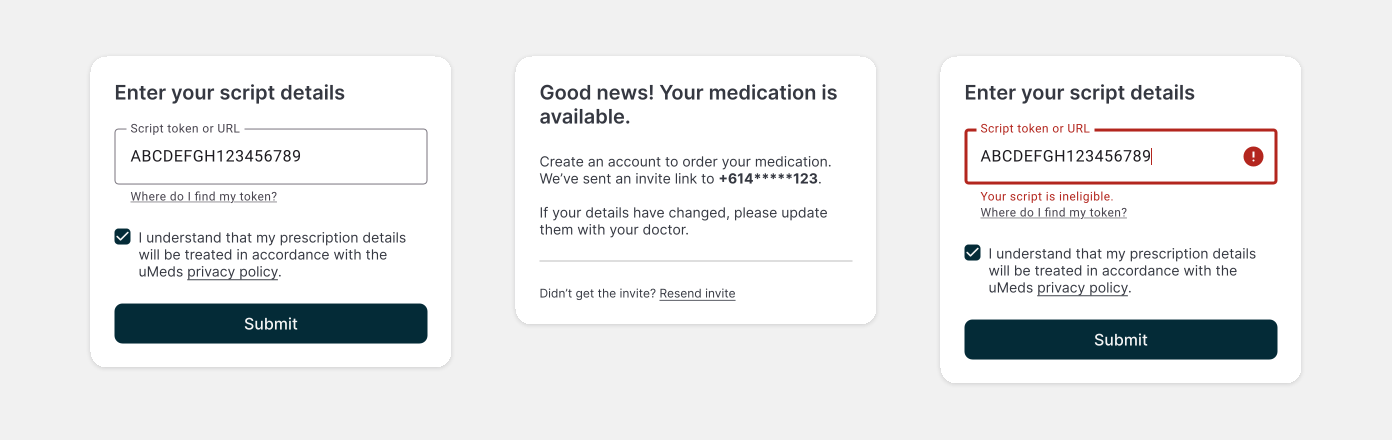
Use the prescription’s existing data instead of asking patients to enter it manually.
uMeds is an Australian platform that allows medicinal cannabis patients to order medication online. Originally, it served only Alternaleaf patients, whose prescriptions synced directly from the clinic. In 2024, the business began exploring a new revenue stream: accepting prescriptions from other clinics.
I took over an initial onboarding concept and streamlined it around one principle: use the prescription’s existing data instead of asking patients to provide their details manually. A simpler patient-facing experience was supported by prescription validation, product matching, identity checks, and exception handling behind the scenes.
Opening uMeds to patients beyond Alternaleaf.
In 2024, uMeds sold approximately 1.81 million units, representing 27.5% of the 6.59 million medicinal cannabis units sold nationally.
| 2024 medicinal cannabis market in Australia | Units sold | Share |
|---|---|---|
| Through uMeds | 1.81 million | 27.5% |
| Outside uMeds | 4.78 million | 72.5% |
| Total | 6.59 million | 100% |
The remaining market suggested room for growth, but it was not all realistically accessible. Prescription access, clinic arrangements, pricing, and patients’ willingness to switch would prove important constraints.
The immediate product challenge was to let an external patient submit a prescription, establish eligibility, create an account, and order medication.
Reduce effort without compromising prescription accuracy or privacy.
The initial wireframes, created by another designer, asked patients for information that could already be retrieved from their prescription. The proposed journey also placed administrative tasks, such as uploading approval documents, on the patient. I saw an opportunity to shorten the journey by changing what the system handled.
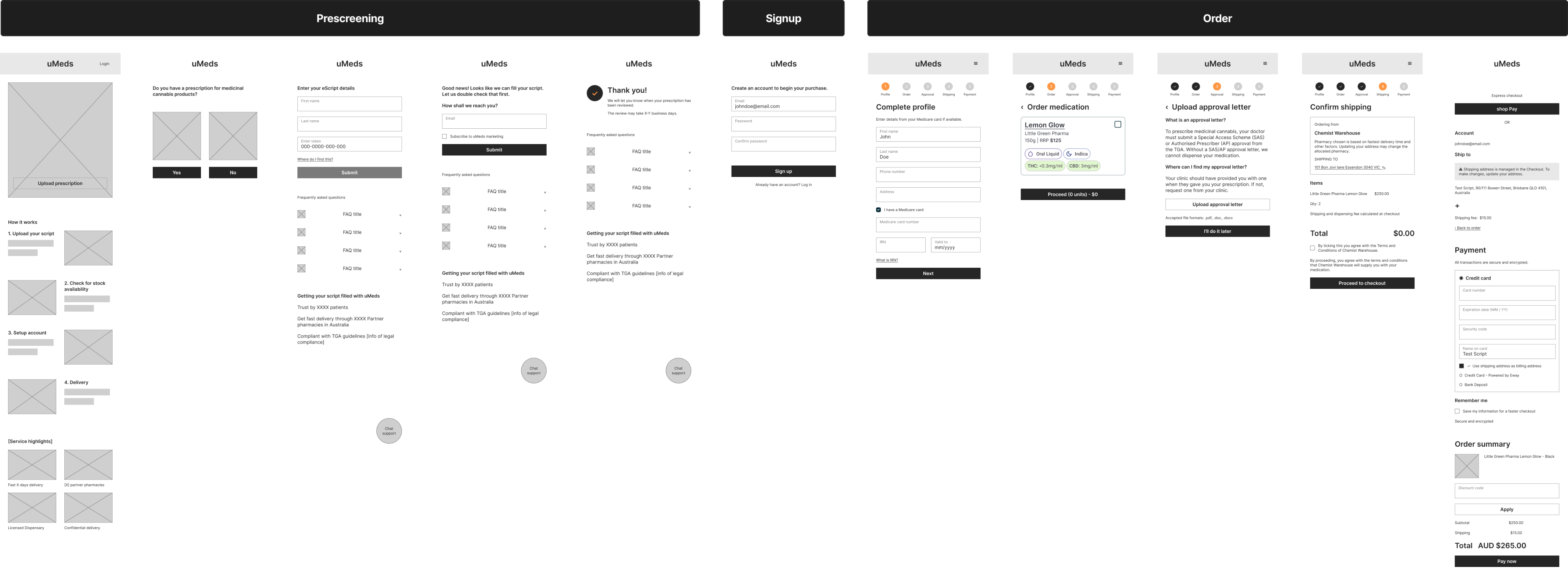
What competitor journeys revealed
Competitors such as CannaDash, Honahlee, and Canary Scripts commonly required account creation before prescription submission. Depending on the service, patients then waited for a manual quote, matched a product to their prescription—a non-TGA-compliant approach—or uploaded documents themselves.
For uMeds, accurate product matching was especially important because payment was taken at checkout. Discovering the wrong product during dispensing could mean correcting both medication and price, introducing delays and administrative work.
The design needed to establish eligibility and resolve product matching before purchase, while limiting unnecessary exposure to products outside the patient’s prescription.
Agree on what the system should do before designing the form.
I led collaborative workshops with Engineering, Service Design, and Product to establish three guiding principles:
- Preserve momentum. Eligible patients should be able to submit a prescription, register, and order within 10 minutes.
- Check eligibility early. Avoid asking someone to create an account before discovering that uMeds cannot fulfil their prescription.
- Protect sensitive information. Tie registration to prescription contact details so signup links reach the legitimate prescription owner.
Prescription eligibility
The service required:
- An electronic, not paper, prescription.
- A medicinal cannabis prescription.
- A named brand and product, rather than an open or generic description.
- A recorded email address or phone number to receive the signup link.
- A clinical discharge pathway where an existing Alternaleaf patient attempted signup with an external prescription.
These were the service’s operational and clinical requirements, not a claim that every criterion applies universally across Australian prescribing.
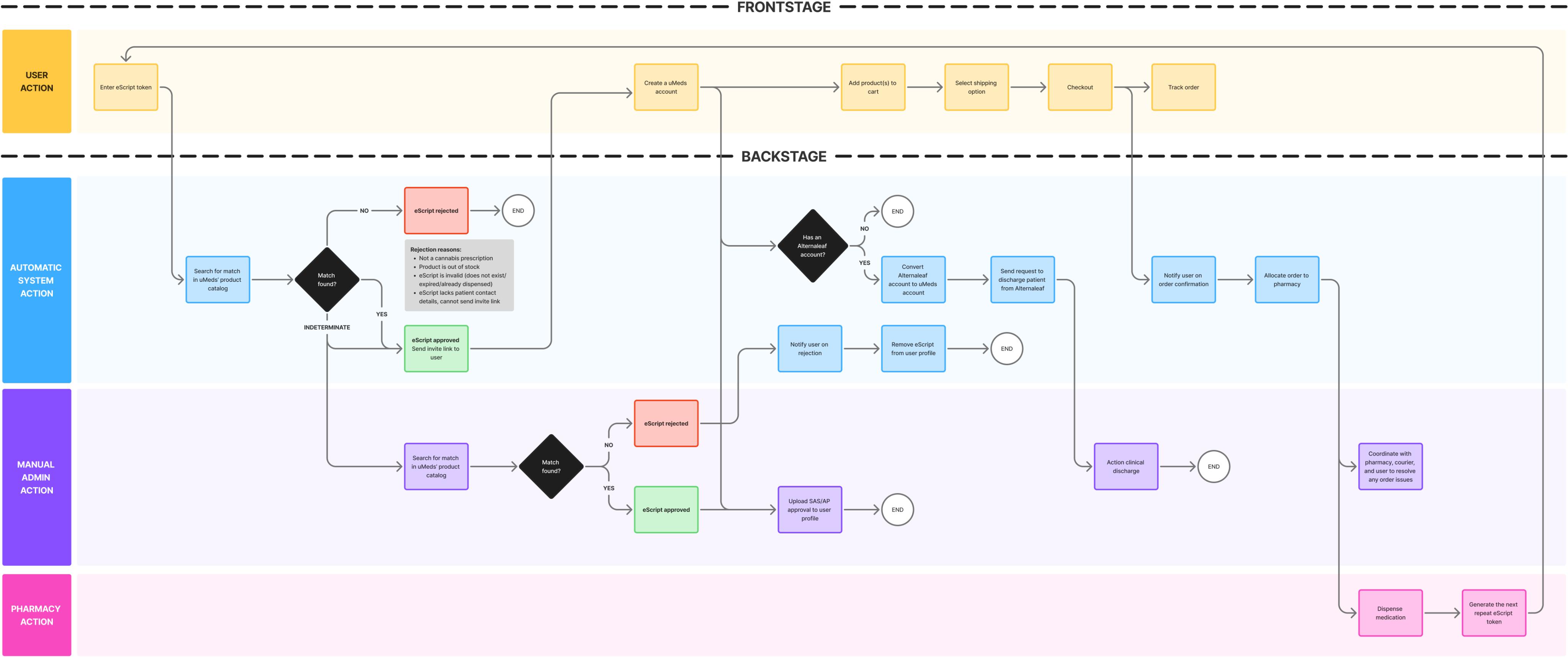
Start with the prescription, not the account.
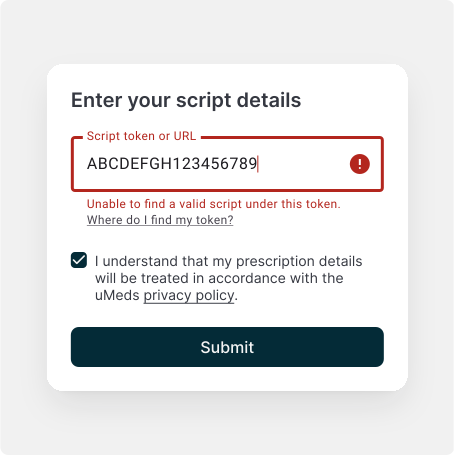
The final design replaced the initial multi-screen prescreening journey with a compact entry point. Patients could check eligibility before committing to account creation.
Retrieve information instead of asking for it again
The eRx integration supplied information for several parts of onboarding:
| Prescription data | How it supported the journey |
|---|---|
| Trade name, generic name, and active ingredients | Match the prescription to a product |
| Recorded phone number or email | Send the signup invitation |
| Individual Healthcare Identifier (IHI) | Support identification and check duplicate or Alternaleaf accounts |
| Name, Medicare details, and residential address | Prefill the patient profile |
Prescription-linked identity details, including full name, date of birth, and residential address, were not editable in this flow, avoiding discrepancies during pharmacy dispensing. Patients could still choose a different delivery address.
Remove document collection from patient onboarding
The initial concept asked patients to upload TGA approval documentation. We removed this task from onboarding and assigned document collection to Fulfilment, avoiding requests for unfamiliar paperwork before ordering.
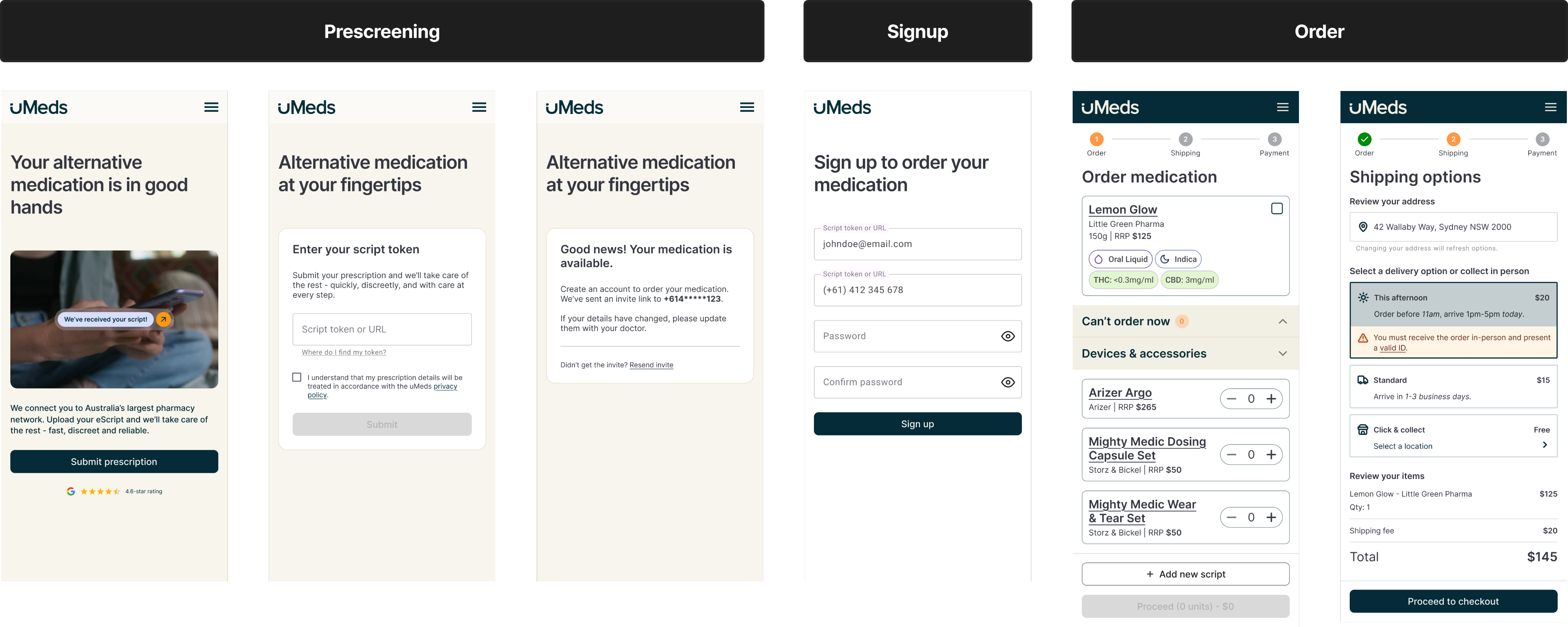
Design for different matching outcomes
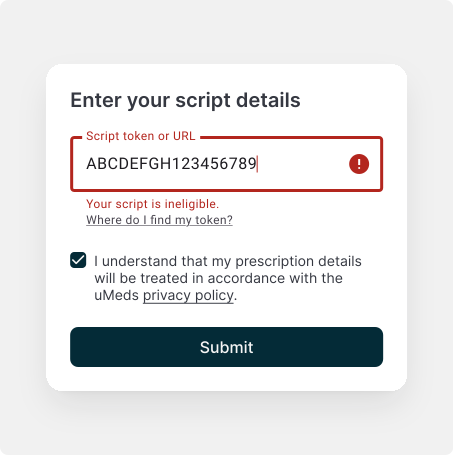
The entry form asked for a script token or URL, explained where to find the token, and included privacy-policy consent. A short form still needed to support several distinct outcomes:
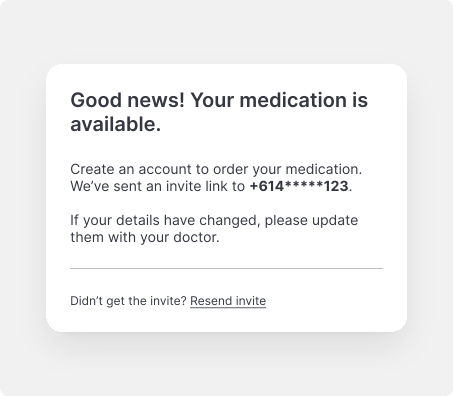
- High-confidence match: confirm medication availability and send an invitation to the prescription contact.
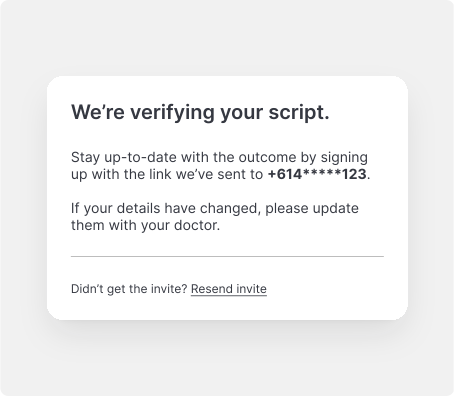
- Low-confidence match: explain that verification is underway rather than promise immediate access.
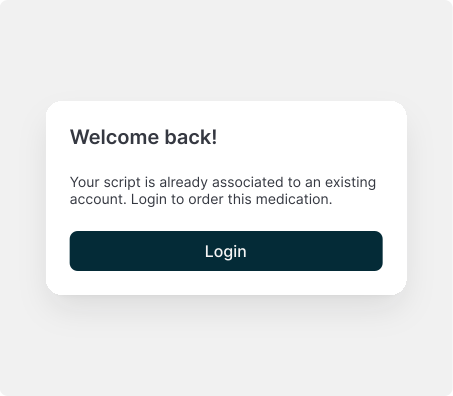
- Prescription already exists: prompt the patient to log in.
- Non-cannabis or generic prescription: explain ineligibility.
- Invalid, expired, or dispensed token: explain that a valid script could not be found.
Invitation states offered resend and directed patients with changed contact details to their doctor. Responsive layouts kept these outcomes clear on smaller screens.
05 / A REUSABLE ONBOARDING CAPABILITY
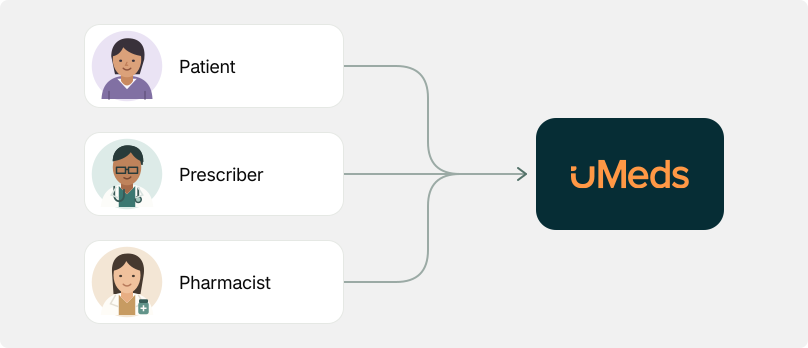
Three acquisition channels. One module.
The prescription submission module was designed to work beyond the public signup page. With patient consent, partner clinics and pharmacies could submit an eScript token through their own uMeds portals. The same validation, matching, and invitation process could support each referral.
This made onboarding a reusable service capability rather than a one-off form.
A streamlined journey, but limited commercial traction.
| First-year measure | Result |
|---|---|
| Patient signups | 361 |
| Revenue | $178,200 |
| Prescriptions automatically matched | 28% |
| Average manual matching time | 7.6 hours |
Even repeat tokens for previously matched products could return to manual review. The intended fast onboarding experience depended heavily on improving the matching system; simplifying the form did not remove this operational bottleneck.
A simpler signup could not resolve a weak switching proposition.
Go-to-market readiness followed launch
The service launched in Q3 2025, but marketing began in Q1 2026. LegitScript certification also started after launch, limiting access to key paid advertising channels.
Trust was another hurdle. At the start of 2026, uMeds had four Google reviews, all 1-star. By Q3 2026, that improved to approximately 1,000 reviews with a 4.5-star overall rating, but the early acquisition environment was difficult.
The available market was smaller than the headline opportunity
Many clinics operated tightly integrated prescribing and pharmacy models, making prescription access and transfer difficult. Patients satisfied with those arrangements had little reason to move; those dissatisfied with restricted pharmacy choice might not find another partner-pharmacy model compelling.
Price and choice mattered more than onboarding alone
Honahlee and Canary Scripts offered pharmacy comparison and choice—a stronger proposition for patients seeking affordability and flexibility. The team identified pharmacy prices on those platforms up to 20% cheaper than uMeds’ recommended retail prices. Convenience alone was insufficient.
Next steps
Improve automatic matching
Investigate why known products and repeat prescriptions still entered manual review. Increasing automatic matching could reduce the delay between submission and ordering.
Integrate Active Script List
This would eliminate the need for patients to submit repeat tokens when reordering, bringing external patients closer to the automatic syncing experience available to Alternaleaf patients.
Research abandonment and churn
Interview patients who submitted prescriptions but did not order, alongside those who stopped returning. Distinguish price and pharmacy choice concerns, waiting time during review, confusing design, and support or trust issues.
This evidence would help determine whether to optimise onboarding, change the broader proposition, or reconsider further investment. These are proposed next steps, not shipped outcomes.
A simple interface needs both a capable system and a compelling reason to use it.
The experience looked straightforward because complexity had moved behind the interface. Prescription data reduced manual entry, early checks avoided unnecessary signup, and Fulfilment took on manual work. But streamlining a journey cannot create demand on its own.